
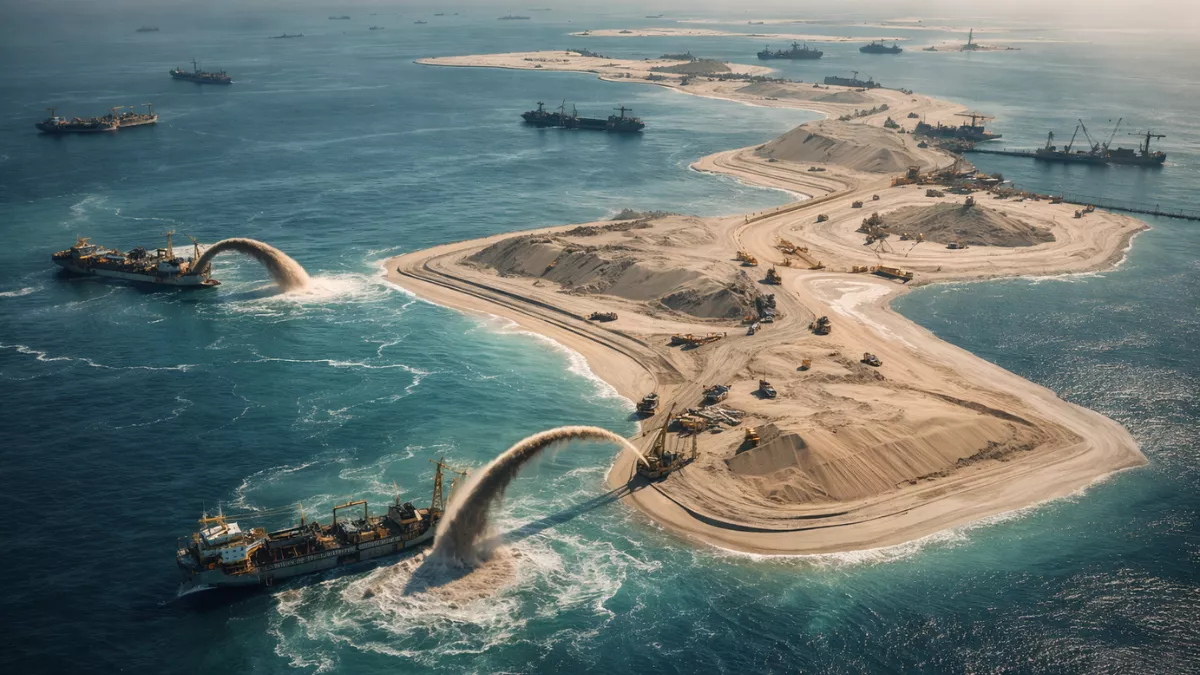
China’s coastline story has expanded far beyond its mainland borders. Through large-scale land reclamation, China artificial islands have emerged where open ocean once existed. Psychology, geopolitics, and environmental science all intersect in this ambitious effort.
For over a decade, massive dredging ships have poured sand, coral, and sediment into shallow waters, gradually forming solid land. This process transformed reefs into runways, ports, and military-capable structures. For a U.S. audience, the scale feels almost science-fiction, yet it is very real.
 Get $2,000 From IRS in February 2026- Direct Deposit, Eligibility, Payment Dates, and Steps to Receive
The creation of China artificial islands reflects long-term planning, strategic dominance, and engineering confidence. While supporters view it as technological progress, critics highlight ecological damage and rising regional tensions. Understanding how these islands were built explains why they matter far beyond Asia.
1. The Engineering Behind China Artificial Islands
The foundation of China artificial islands lies in advanced dredging technology. Giant cutter suction dredgers extract sand from the seabed and spray it onto reefs. Over time, layers compact into stable land. Engineers then reinforce surfaces with concrete and seawalls.
 Social Security Benefits Increase in 2026: What Beneficiaries Should Know
This method allows land to rise above sea level within months. Unlike natural islands, these are designed for specific purposes such as airstrips and harbors. The scale is unprecedented, with thousands of acres created. For engineers, it represents mastery over marine construction. For observers in the U.S., it signals how infrastructure can redefine geography itself. These islands did not appear overnight, but through steady, calculated expansion.
2. Strategic Motivation Behind the Expansion
The motivation behind China artificial islands is largely strategic. Many are located in contested waters, strengthening territorial claims. By building permanent structures, China reinforces its presence without traditional conquest. Military analysts note the placement allows radar systems, airfields, and docking stations.
 Federal Deposit Holds Add 2026: Why $2000 to $3000 Delays After Identity Reviews
This shifts power balance in key shipping routes. For global trade, these waters are vital, carrying trillions of dollars annually. The islands act as unsinkable platforms, extending operational reach. From a U.S. perspective, this raises concerns about freedom of navigation. These man-made lands are not just engineering feats; they are tools of influence shaping future maritime control.
3. Environmental Impact and Ecological Cost
Environmental scientists warn that China artificial islands come with heavy ecological consequences. Dredging destroys coral reefs that take centuries to recover. Marine habitats are buried under sand, disrupting biodiversity. Water quality declines as sediment clouds spread. Fisheries near reclaimed areas often collapse, affecting coastal communities.
 IRS Today Announced $2,000 Direct Deposit for All – February 2026 New Payment Schedule & Eligibility Guide
While development brings strategic benefits, environmental loss is permanent. For Americans concerned about climate change and ocean health, this raises red flags. Artificial islands also alter tidal patterns, impacting erosion elsewhere. The ecological cost is often invisible from above but profound below the surface. This tradeoff fuels international criticism and environmental debate.
4. Legal and Political Repercussions
The rise of China artificial islands has sparked legal disputes. International maritime law does not always recognize man-made land as sovereign territory. Several rulings challenged the legitimacy of territorial claims based on reclaimed islands. Despite this, construction continued.
 Social Security Payment Update: Millions May Qualify in 2026
Politically, the islands became symbols of national strength. For neighboring nations, they represent encroachment. For the U.S., they complicate diplomatic relations and regional security. Naval patrols increased in response. The islands stand at the center of a legal gray zone where engineering advances outpace existing laws. This tension keeps the issue in global headlines.
5. Economic and Infrastructure Advantages
Beyond defense, China artificial islands support economic goals. Ports facilitate shipping and resource exploration. Airstrips reduce travel distance for logistics. Over time, infrastructure transforms reefs into hubs of activity. Construction itself creates jobs and advances domestic engineering expertise.
For China, these islands demonstrate self-reliance and industrial capacity. From an American viewpoint, it highlights how infrastructure investment can project power abroad. The islands also serve as testing grounds for future coastal expansion. Economic advantage, paired with strategic presence, makes these projects highly valuable despite controversy.
Table: Key Aspects of China Artificial Islands
| Aspect | Impact |
|---|---|
| Engineering | Advanced dredging and land reclamation |
| Strategy | Expanded military and territorial reach |
| Environment | Coral destruction and habitat loss |
| Law | Challenges under international maritime rules |
| Economy | Enhanced shipping and infrastructure |
Conclusion
After more than a decade of construction, China artificial islands have permanently altered ocean geography. What began as sand dumping evolved into strategic strongholds with global implications. For the U.S. audience, these islands symbolize how technology, ambition, and geopolitics intersect.
While they showcase engineering power, they also raise serious environmental and legal concerns. The future impact of China artificial islands will shape regional security, trade routes, and international law for decades to come. Their existence proves that modern nations can now create land itself, changing the rules of global influence.
FAQs
How long did it take to build China artificial islands?
Most were developed gradually over more than ten years.
Are China artificial islands legally recognized?
International law largely disputes territorial claims based on man-made islands.
Do these islands harm marine life?
Yes, dredging and reclamation significantly damage coral ecosystems.
Why do these islands concern the U.S.?
They affect regional security, trade routes, and freedom of navigation.
✨ You May Also Like ✨