
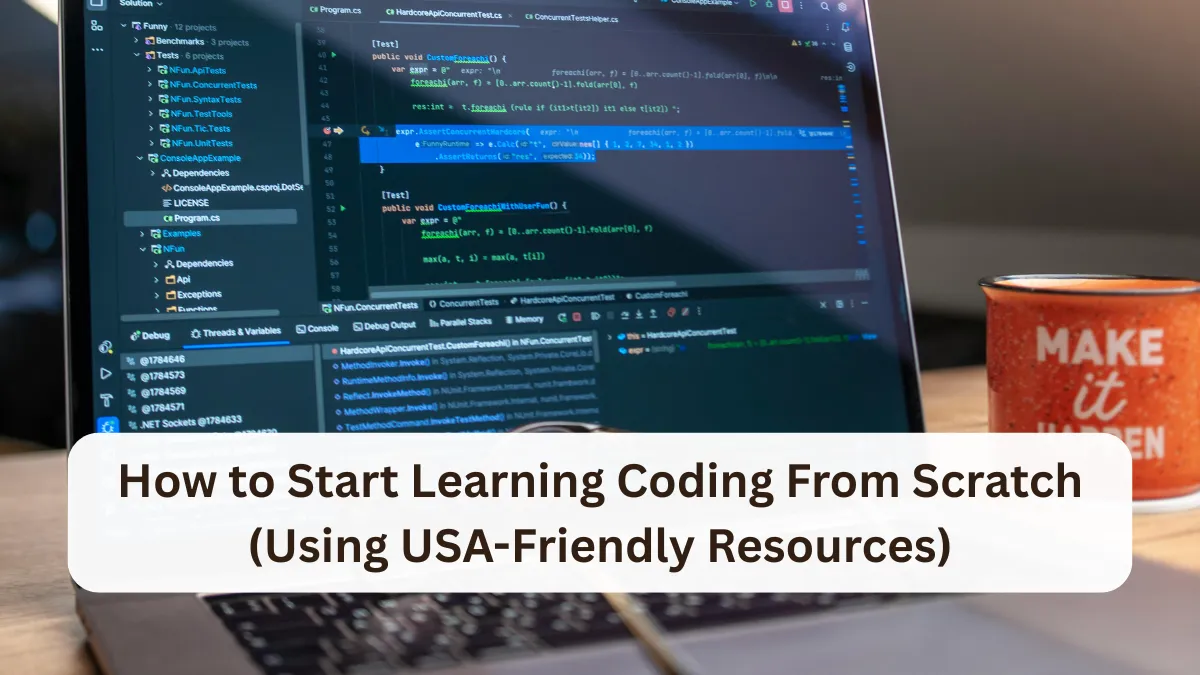
Learning to code from scratch can feel overwhelming, especially if you live in the US, have a busy schedule, and no technical background at all. Many people worry they are “too old,” “not techy enough,” or “too busy” to start, so they never take the first step.
The good news is that you can begin with simple, free resources made for complete beginners in the United States and move forward at your own pace.


Why Learning to Code Feels So Hard at First
For most beginners, the problem is not intelligence; it is confusion and information overload.
- There are hundreds of languages, courses, and websites, which makes it hard to choose where to start.
- Many tutorials assume you already understand basic computer terms.
- Adults and seniors may feel intimidated by younger people who “grew up with technology.”
- Students and working professionals often struggle to fit learning into already busy days.
On top of that, a lot of people start randomly watching videos or reading blogs without any plan. They jump from one topic to another, never finish a project, and then conclude coding “is not for them.”
A simple, structured path with realistic US-based resources solves most of these problems.
Step 1: Get Clear on Your Goal
Before picking any course or language, spend a little time on your “why.”
Ask yourself:
- Do you want a new career later, or just basic skills?
- Are you more interested in websites, apps, data, or automating tasks at work?
- How much time can you honestly give per week (for example, 3–5 hours)?
Some examples for people in the US:
- A community college student who wants to build small websites can start with HTML, CSS, and basic JavaScript.
- A nurse or office worker who wants to automate spreadsheets or data might start with Python.
- A high school student who enjoys games might try basic JavaScript game projects or interactive platforms.
Having a simple written goal like “I want to build a basic personal website in the next two months” makes it easier to choose the right path and stay motivated.
Step 2: Choose a Beginner-Friendly Language
You do not need to learn every language. Starting with one, then adding more later, works well.

Common beginner choices in the US:
- Python – Great for beginners, used in data, automation, and many entry-level courses. freeCodeCamp and many other platforms offer Python basics for free.
- JavaScript – Ideal if you want to build websites and front-end projects; many free US-focused platforms teach JavaScript from zero.
- HTML & CSS – Not “full programming languages,” but essential building blocks for any website. Many US-based beginners start here before moving into JavaScript.
If you are not sure, starting with HTML, CSS, and basic JavaScript is a safe option for web, while Python is a solid choice if you are more interested in general problem-solving, automation, or data.
Step 3: Start With One Structured Free Course
Instead of jumping between random tutorials, pick one structured beginner program and follow it from start to finish.
Some widely used, free options for US learners:
- freeCodeCamp – A nonprofit offering a full beginner curriculum in web development and JavaScript, with hands-on projects and free certifications.
- Codecademy (Free Tier) – Interactive lessons in Python, JavaScript, HTML/CSS, and more; very beginner-friendly for people starting from scratch.
- Khan Academy – Great for younger learners and complete beginners, with interactive coding videos and exercises.
- MIT OpenCourseWare – Introductory Programming – Free materials from MIT’s beginner programming courses; useful once you are comfortable with basics and want deeper understanding.
Pick only one to start. Commit to something realistic, like “30 minutes a day, five days a week, for six weeks.”
Step 4: Learn the Fundamentals, Not Just Copying Code
In the beginning, you will write very small programs, and that is normal. Focus on understanding a few core ideas:
- Variables (storing information)
- Conditions (if this, then that)
- Loops (repeat something several times)
- Functions (reusable blocks of instructions)
Many beginner platforms in the US, like freeCodeCamp and Codecademy, walk through these concepts step by step with interactive exercises.
When you complete an exercise, do not just move on. Change a few lines and see what happens. That habit helps your brain understand what the code really does.
Step 5: Practice With Small, Real-Life Projects
Reading and watching is not enough. You learn coding by doing.
After a few weeks, try small, realistic projects:
- A simple personal homepage with your photo, city, and hobbies (HTML, CSS).
- A basic “tip calculator” that helps you split a restaurant bill (JavaScript or Python).
- A short script that renames files in a folder or processes a simple CSV file (Python).
Project-based learning is a major focus of platforms like freeCodeCamp and The Odin Project, which are commonly recommended free resources for beginners in the US.
Keep projects small at first. It is more motivating to finish a small project than to start something huge and never complete it.
Step 6: Use US-Friendly Free Resources Wisely
There are many excellent free resources designed for beginners in the United States. A few helpful categories:
- Full learning paths
- Interactive lessons
- Open course materials
- YouTube channels (for visual learners)
Treat these resources like a “toolbox.” You do not need to use everything at once. Start with one main path and occasionally use videos or additional tutorials when stuck.
Step 7: Build a Simple Routine That Fits Your Life
Coding does not require full-time study, but it does require consistency.
For different types of learners in the US:
- Busy working professionals
- 25–40 minutes after dinner, 4–5 nights a week
- One small project each month, like a portfolio page or small automation
- Students
- Short daily sessions after school or between college classes
- Join a school coding club or online community to stay motivated
- Seniors or retirees
- 20–30 minutes in the morning, when your mind feels fresh
- Focus on gentle, visual resources like Codecademy, Khan Academy, or Code.org
The key is to treat it like learning a musical instrument: frequent, short practice sessions build more skill than a big, once-a-week marathon.
Step 8: Join a Community (Even Quietly)
Being around other learners makes it easier to stay on track and get help.
Options that work well for US beginners:
- Online forums and subreddits dedicated to learning programming, where many people share beginner tips and answer simple questions.
- Discussion boards on platforms like freeCodeCamp or The Odin Project, which include many American learners and mentors.
- Local community college classes or community center coding workshops that provide in-person support.
You do not have to be very active. Even reading others’ questions and answers can help you avoid common mistakes.
Step 9: Practice Problem-Solving, Not Just Tutorials
Once you are comfortable writing basic code, start doing small coding challenges.
- Beginner-friendly sites like LeetCode and HackerRank provide simple exercises you can filter by difficulty.
- Many people use these platforms a few times a week to strengthen logical thinking.
You do not need to focus on highly advanced problems. Solving easy challenges regularly builds confidence and prepares you for more complex projects later.
Helpful Tips and Common Mistakes to Avoid
Helpful Tips
- Start tiny and finish things
A simple “to-do list” app or one-page website is a win. Finished small projects are better than half-done big ones. - Keep a learning journal
Write down what you learned each day in plain language. This habit is especially useful for adults returning to study and for seniors. - Revisit old code
After a few weeks, go back to an earlier project and improve it. You will clearly see your own progress. - Use plain English explanations
When a concept feels confusing, try to explain it to yourself in everyday language. If you can explain it simply, you probably understand it.
Common Mistakes
- Switching languages too often
Jumping from Python to JavaScript to something else every week slows your progress. Stick to one language until you are comfortable. - Only watching, never typing
Passive watching feels easier, but you learn very little. Always type along with tutorials and try your own changes. - Comparing yourself to others
Younger people or full-time students may move faster. Your pace is fine as long as you are consistent. - Expecting instant results
Coding is a skill, like learning a new instrument or language. It can take a few months before you feel truly comfortable.
Simple Beginner Roadmap (First 3 Months)
Here is a realistic, flexible path many US beginners can follow:
- Weeks 1–2
- Weeks 3–6
- Weeks 7–12
You can stretch or shorten this roadmap based on your schedule, but keeping a clear timeline helps you stay focused.
Conclusion
Learning coding from scratch in the United States does not require a special background, expensive bootcamps, or perfect math skills. It requires a clear goal, a beginner-friendly resource, small consistent steps, and the willingness to practice even when it feels slow.
If you start with one language, follow one structured course, build tiny projects, and keep a simple routine that fits your life, you will gradually move from “I have no idea what this means” to “I can build something that actually works.” That quiet progress is what truly matters, no matter your age or starting point.
FAQ’s
Am I too old to start learning coding?
Do I need a powerful computer to begin?
How long does it take to feel comfortable coding?
✨ You May Also Like ✨